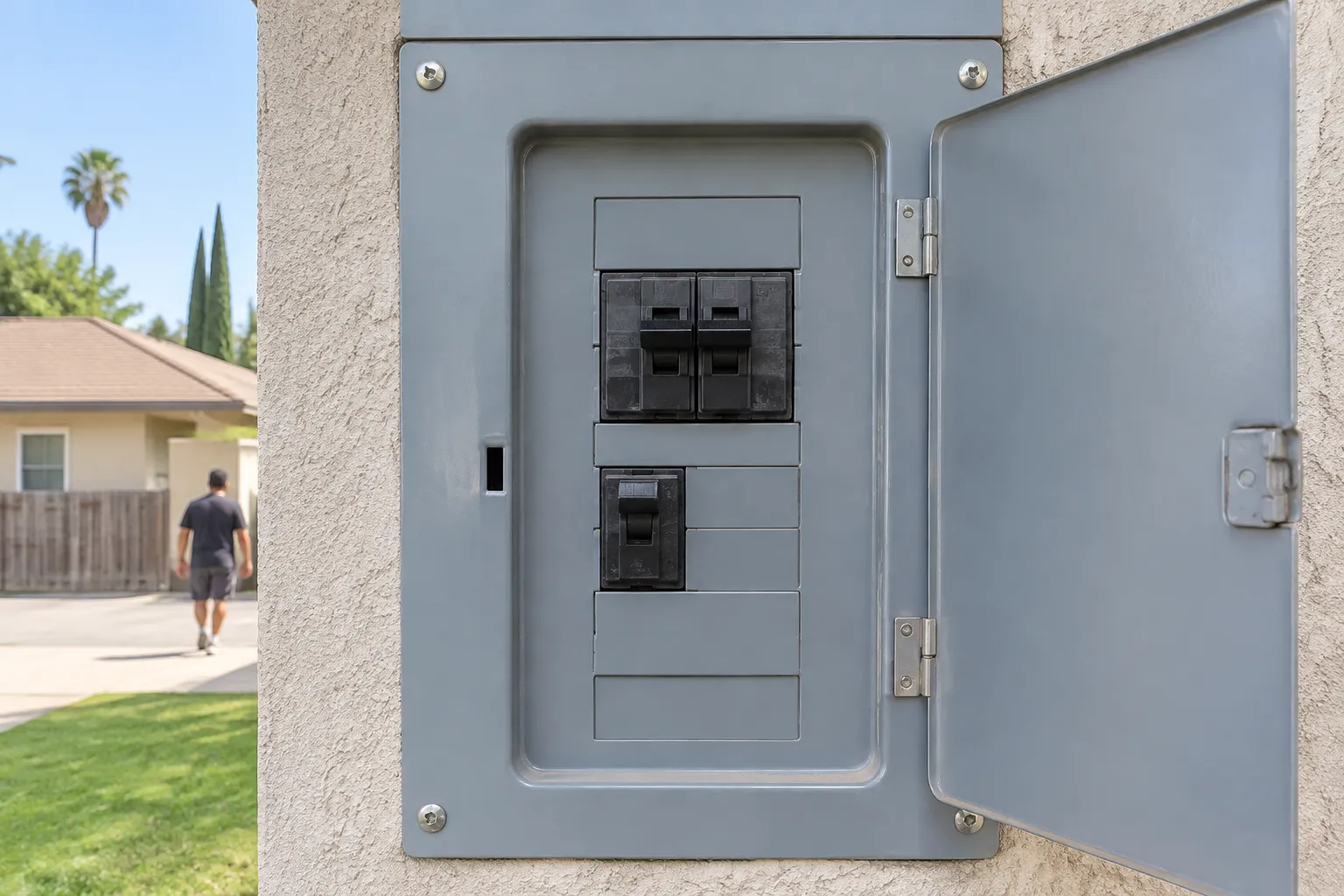
A GFCI (ground-fault circuit interrupter) protects people from electric shock by cutting power when current leaks to ground. An AFCI (arc-fault circuit interrupter) protects buildings from fire by cutting power when it detects dangerous arcing in wiring or cords. They do different jobs, and some rooms need both. Both are types of circuit breaker or outlet that trip on purpose.
If one of them keeps tripping, start with the main guide to a circuit breaker that keeps tripping. This page covers what each device senses, where each is used, how to test them and when a trip needs an electrician in Stockton.
What do AFCI and GFCI mean for your home?
A GFCI senses current leaking out of the normal path, often through a person or water, and shuts off in a fraction of a second. An AFCI senses the electrical signature of an arc, such as from a nicked cable or a loose connection, and shuts off before the arc heats nearby material. One guards people, the other guards the structure.
Here is a side-by-side:
| GFCI | AFCI | |
|---|---|---|
| Protects | People from shock | Wiring and building from fire |
| Senses | Current leaking to ground (about 4 to 5 milliamps) | Arcing in wires, cords and connections |
| Typical places | Bathrooms, kitchens, garages, outdoors, laundry, crawl spaces, unfinished basements | Bedrooms, living areas, kitchens and laundry, depending on code edition |
| Forms | Outlet with test and reset buttons, or a breaker | Breaker, or in some cases an outlet |
| Common cause of nuisance trips | Moisture, worn appliance | Loose connection, damaged cord, some motors |
Code requirements have expanded over time, and which devices your home has depends on when it was built or last rewired. A home built before AFCI rules may have none. The current California electrical code adopts the National Electrical Code with changes, so ask an electrician or the City of Stockton or San Joaquin County building department what applies to a specific job.
What is the difference between an AFCI and a GFCI breaker and outlet?
The sensing is different, but the form is the same: both come as breakers in the panel or as outlets in the wall. A GFCI outlet protects itself and outlets downstream on its wiring. A GFCI breaker protects the whole circuit. An AFCI is most often a breaker, and it protects the whole circuit including wall wiring and cords.
A "dual function" breaker is both an AFCI and a GFCI in one device. Do not assume from the word "combination" on a label: a combination AFCI covers two kinds of arcing, which is different from GFCI protection. Look for a label that says the device is both AFCI and GFCI. Dual-function breakers cost more than standard ones. See the GFCI outlet installation cost page for typical prices, and the GFCI outlet installation guide for how the wiring works.
An outlet marked GFCI does not protect against arcs, and an AFCI breaker does not protect against shock. That is why a bathroom or kitchen circuit can need one device or both.
Does the bathroom need an AFCI or a GFCI?
A bathroom outlet needs GFCI protection, because water and electricity together cause shock. An AFCI is not normally required for bathroom outlets, though your circuit may have one if it also feeds a bedroom or other room covered by AFCI rules. When in doubt, ask an electrician what your panel has and what current code expects.
If a bathroom GFCI trips often, check for moisture in the outlet, a hair dryer or heater with a damaged cord, or a damp exhaust fan. A GFCI that will not reset might be worn out. They have a limited life, and Safe Electricity advises testing a GFCI monthly.
When do you use an AFCI and when a GFCI?
Use a GFCI where water or damp surfaces raise the shock risk: bathrooms, kitchens, outdoors, garages, laundry areas, crawl spaces and unfinished basements. Use an AFCI on circuits that run through living spaces, where damaged wiring or cords could start a fire in walls and furnishings. Many circuits in current homes have both, as a dual-function breaker or an AFCI breaker plus a GFCI outlet.
Rules differ by code edition and by whether the work is new, a repair or a remodel, so do not guess for a particular job. Adding or replacing a protective device is electrical work, and California law requires work for others to be done by a contractor holding a C-10 electrical license from the Contractors State License Board. You can ask a local electrician to review a panel and tell you which circuits are protected, which are not and what an upgrade would involve.
Why does my AFCI or GFCI keep tripping?
A GFCI trips when current leaks to ground, usually from moisture or a failing appliance. An AFCI trips when it senses an arc, which can come from a damaged cord, a loose terminal or sometimes from a device with a motor. Unplug everything on the circuit and add items back one at a time to find the cause.
If the trip continues with nothing plugged in, the fault may be in the wall wiring or a loose neutral. That is a job for an electrician. Also read why a breaker keeps tripping for causes that apply to every breaker type. If the AFCI trips only when a window or central air conditioner starts, the air conditioner breaker article explains why.
How do you test an AFCI or GFCI?
Press the test button, which should cut power, then press reset to restore it. Safe Electricity advises doing this for a GFCI monthly, and an AFCI breaker's label or manual says how often to test it. A GFCI outlet has test and reset buttons on its face. An AFCI breaker has a test button on the breaker in the panel. If the device does not trip when tested, or will not reset, replace it with an electrician's help.
Plug in a lamp or radio to confirm power goes off. For a GFCI outlet, tell the household before testing so no one loses unsaved work. Opening the panel cover to test an AFCI is something most electricians will do for you, and breakers must match the panel type, so do not swap one yourself.
What to do next if one keeps tripping
Unplug everything on the circuit, reset once and add items back one by one. If one item trips it, repair or replace that item. If nothing is plugged in and it still trips, stop. A repeat trip with no load is the point to get quotes from local electricians.
Call 911 for smoke, sparks or a burning smell. For other cases, see when to call an electrician in the main guide, and read how to choose an electrician before you book.
Questions people ask
How long does an AFCI or GFCI replacement take?
Swapping a GFCI outlet often takes under an hour. Replacing an AFCI or dual-function breaker usually takes under an hour once the electrician has confirmed the cause. If testing shows damaged wiring behind a repeated trip, the job grows. Your electrician can say how long it will take once they have tested the circuit.
What should I ask before I hire someone for AFCI or GFCI work?
Ask for their C-10 electrical license number and check it on the CSLB website. Ask whether the quote includes testing the circuit to find why it tripped, whether a permit applies, whether the device is a breaker or an outlet, and what the part costs separately from labor.
Do I need to be home for AFCI or GFCI work?
Usually yes, at least at the start, so the electrician can reach the panel and test outlets. Power will be off to some circuits for a while, so plan around fridges and medical or work equipment. Someone should be there at the end to test the new device with the electrician.
Is a GFI the same as a GFCI?
Yes. GFI and GFCI both refer to a ground-fault interrupter. GFCI, for ground-fault circuit interrupter, is the standard term in codes and on labels. People also say GFI casually. It is not the same as an AFCI, which detects arcs rather than ground leakage.
Can an AFCI replace a GFCI?
Not on its own. An AFCI senses arcs and does not protect against shock. Where code requires GFCI protection, you need a GFCI or a device marked as a combination AFCI and GFCI. Check the label, and have an electrician confirm which protection each circuit in your home has.
Sources used
- Safe Electricity, Ground Fault Circuit Interrupters
- Electrical trade press, NEC requirements for GFCIs and AFCIs (summary of 2023 NEC 210.8 and 210.12)
- CSLB C-10 Electrical Contractor classification
- Published 2025 and 2026 US price guides for AFCI and GFCI devices
Last changed