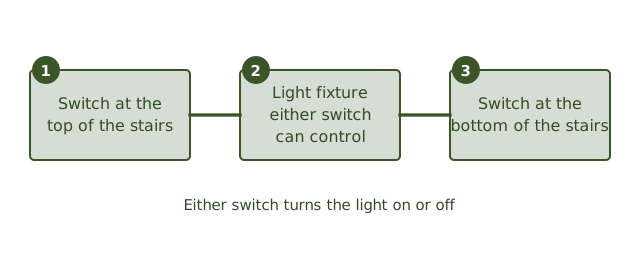
A light switch breaks the hot wire to a light. A single-pole switch does it from one place. A 3-way switch has two extra "traveler" wires so two switches in different places can control the same light, and a 4-way switch sits between them for a third or fourth location. The wire you use for a 3-way run has three conductors plus a ground, which is why a switch box can look crowded. This article is part of the outlets, switches and GFCI guide. Understanding the wiring helps you read your own walls and talk to an electrician. It does not replace the wiring diagram on the switch you buy.
How is an ordinary light switch wired?
A single-pole switch interrupts the hot wire to the light and nothing else. Power arrives at the box, goes through the switch and carries on to the fixture. When the switch is off, the circuit is open and the light has no power. It has two screw terminals, plus a green ground screw.
A typical single-pole box has a cable with a black hot, a white neutral and a bare ground. The black wire connects to one terminal and the black wire to the light connects to the other. Which terminal is which does not matter on a single-pole switch. The ground connects to the green screw and the neutrals join together behind the switch, bypassing it.
Modern code expects a neutral wire in many new switch boxes so that smart switches and timers can run. In an older home you may find only a hot and a switched hot, with the white wire re-marked as a hot. That is called a switch loop, and it explains why some switch boxes have no neutral at all.
Why is it called a 3-way switch and not a 2-way switch?
The name counts something other than the number of positions. A 3-way switch has three terminals: one common and two travelers. In the United States, a "2-way" switch is a plain on-off switch, and a 3-way switch lets you pick between two paths. The name comes from the three terminals, not the number of locations.
According to the Wikipedia article on multiway switching, a US 3-way switch has a common terminal and two traveler terminals, and flipping it disconnects one traveler and connects the other. Two such switches linked by a pair of travelers let either one change the light.
Other names add to the confusion. In some countries a "two-way switch" means what Americans call a 3-way. If you are following a video or diagram from another country, check that the terms match your wiring.
How do you wire a 3-way light switch?
In a 3-way circuit, power goes to the common terminal of one switch, two traveler wires link the other terminals on both switches, and the common terminal of the second switch goes on to the light. Flipping either switch changes the path, so the light turns on or off from either place.
The key ideas:
- The common terminal is usually a darker screw. One switch gets the incoming hot on it. The other has the wire to the light on it.
- The travelers are the two wires between the switches. They connect the two remaining terminals on each switch and are interchangeable at each end.
- The neutral passes through the boxes and goes to the light. It never touches the switches.
- The ground connects to every metal box and switch.
The pattern changes with where the power enters, whether it arrives at the switch or at the light first. That is why a diagram for one house will not work for another. If you cannot trace the wires with the power off, call a local electrician.
Why would a light switch have three wires?
A switch box with three wires usually has a 3-way circuit, because the cable between the two switches carries a hot, a neutral, a traveler and a ground. Two travelers in a 14/3 or 12/3 cable explain the red wire you see. A box with three wires can also be a switch with a neutral.
Cable names help you read what you have. A 14/2 cable has two insulated wires and a ground. A 14/3 cable has three insulated wires, usually black, red and white, plus a ground. In a 3-way run, the black and red are the travelers, and the white is the neutral. Check the writing on the cable jacket and confirm with a tester when the power is off.
How do you wire a 3-way switch with only 3 wires?
If a switch box has only three wires, you most likely have a ground and two conductors that serve as travelers or as the common and a traveler. This happens in older homes. The right connection depends on where the power enters, so identify each wire with a tester and the power off, or ask an electrician.
Do not guess. Connecting a traveler to the common terminal, or leaving the neutral disconnected where it is needed, gives a light that works from only one switch or not at all. Do not connect the white wire to a switch terminal unless it has been marked as a hot, with tape or a color, and you know it carries power.
What happens if a 3-way switch is wired wrong?
A wrongly wired 3-way usually shows up as a light that works from only one switch, works backwards or does not work at all. A worse mistake, such as connecting hot to neutral, trips the breaker at once. Switch off the breaker and do not keep trying.
Typical symptoms:
- The light only turns on from one switch.
- Flipping one switch does nothing.
- The breaker trips when a switch is flipped.
- A switch gets warm.
A breaker that trips every time is a stop sign. See why a breaker keeps tripping before you reset it again.
What about 4-way switches and dimmers?
A 4-way switch goes between two 3-ways when three or more locations control one light. It has four terminals and passes the travelers straight through or crosses them, depending on its position. A dimmer replaces one switch and needs a model matched to the bulbs.
- 4-way wiring. The travelers from the first 3-way enter two terminals on the 4-way and leave through the other two toward the last 3-way. Mixing up the pairs gives odd on-off behavior. Search terms such as "four way electrical switch wiring" all mean this setup.
- Dimmers. Check the label for the bulb type, usually LED or incandescent. A mismatch is a common cause of buzzing and flickering lights.
- Smart switches. Many need a neutral at the box, which older homes may lack.
- A ceiling fan with a light on one switch. The fan and light run on separate wires from one switch box and need a switch built for it. See ceiling fan installation wiring.
- Lighting upgrades. If you are planning fixtures as well, the lighting electrician page covers that work.
Can you wire a light switch yourself in California, and when should you hire someone?
Owners may do electrical work on their own property under an exemption the Contractors State License Board describes, within limits. Work for other people must be done by a contractor holding a C-10 electrical license. A simple like-for-like swap is within reach for many people if the power is off and tested dead.
DIY is reasonable for:
- Replacing a worn single-pole switch with the same type.
- Replacing a switch cover.
- Fitting a dimmer or a smart switch that matches an existing neutral and wires.
Call a local electrician for:
- Adding a new switch, new light or new circuit.
- A 3-way or 4-way you cannot trace.
- Cloth-covered wire, aluminum wire or burned insulation.
- A box without a ground or with a missing neutral where the new device needs one.
- Any switch that is hot, buzzing or scorched.
New wiring usually needs a permit and inspection. Ask the City of Stockton permit center what your job needs. If you want a quote, electrical help in Stockton can trace the circuit and give you a price.
Questions people ask
What wire do I use for a 3-way switch?
Use cable with an extra conductor, such as 14/3 for 15-amp circuits or 12/3 for 20-amp circuits. It has black, red and white insulated wires plus a ground. The black and red act as travelers. Match the wire gauge to the breaker size, and check the rules with an electrician before you run new cable.
What happens if I swap the two traveler wires?
On a standard 3-way setup, swapping the two travelers at one switch usually does not stop the circuit working. It may reverse which switch position means on. Mixing a traveler with the common wire is the mistake that breaks the circuit.
Do I need a neutral at a light switch?
Not for a simple switch. Smart switches, timers and some dimmers need a neutral at the box to power their electronics. Modern code expects one in many new switch boxes, but older homes often lack it. An electrician can tell you whether yours has one.
Is a 3-way switch the same as a dimmer?
No. A 3-way switch controls a light from two places. A dimmer changes the brightness. Some dimmers are made for 3-way circuits and are labeled so, and they cost more than a standard dimmer. Using the wrong type gives a light that does not dim or flickers.
How much does it cost to wire a light switch?
Prices depend on whether it is a like-for-like swap or new wiring, how far the cable runs and whether a permit is needed. The electrician's own quote is what counts. See the cost of outlet and switch work for the typical bill lines.
Sources used
Last changed